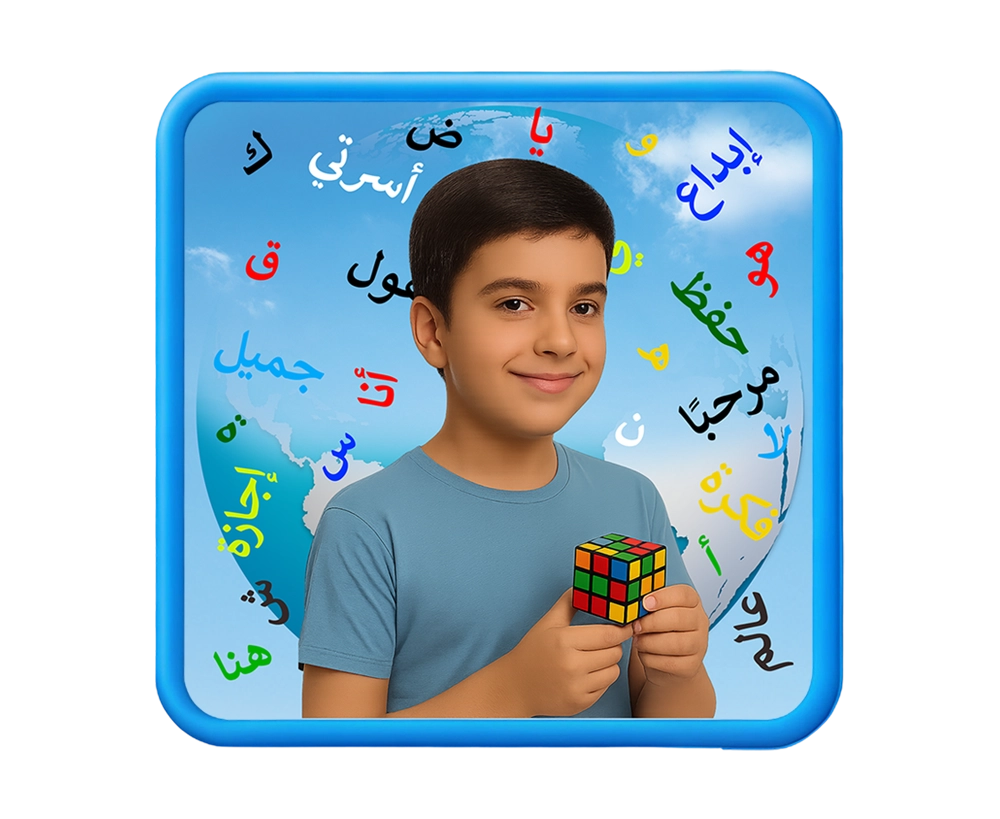
Teaching Arabic Through a Language Environment
- Posted by أ. مصطفى وصَّال
- Date August 21, 2025
- Categories Arabic
- Comments 0 comment
This article discusses the difference between how native speakers acquire Arabic and how non-native learners study it, highlighting the role of the environment in building language skills. It also presents a practical approach to creating a classroom environment that helps learners acquire the language in a natural and accessible way.
When we reflect on how an Arab child learns their language, we find that they do not begin by studying grammar or memorizing words from a book. Rather, they acquire the language naturally from the environment in which they live. From their very first day, they listen, then gradually begin to understand words and connect them to what surrounds them. After that, they start speaking step by step, acquiring over time the dialect, accent, and patterns of expression from their family and the surrounding community—without even realizing that they are “learning.”
Here, an important idea emerges:
Language is not first memorized—it is lived.
On the other hand, the non-Arab learner does not live in an Arabic environment; instead, they enter a classroom to learn the language. Therefore, the classroom itself becomes the “environment” from which they acquire everything. For this reason, this environment must be as Arabic as possible, accurate in pronunciation, and clear in expression—especially since many learners study Arabic to understand the Qur’an. This makes proper pronunciation and the use of standard Arabic (Fusha) extremely important.
The Arab child lives the language daily, hears it all the time, and speaks it naturally without effort. In contrast, the non-Arab learner hears Arabic only during class time and does not use it outside the classroom. Therefore, they need guided support to acquire it step by step. For this reason, we cannot teach both groups in the same way.
Many teachers begin by teaching letters, reading, or grammar. However, the most important truth is that the correct starting point is to create a language environment inside the classroom, where the learner hears Arabic, sees its meaning, and interacts with it—even if the available time is limited.
In reality, most students attend classes only one or two days per week, for about three to five hours. During this time, they study Arabic, the Qur’an, Islamic studies, and participate in activities and breaks. This means the time is very limited compared to the learning goals.
Here lies the real challenge:
How can we create a language environment within such limited time?
The solution is not to increase explanation, but to change the teaching approach. A teacher can create an Arabic environment inside the classroom by speaking Arabic intelligently—using few words and short, clear sentences without over-explaining or complicating matters.
Speech should also be supported with body language and gestures, such as pointing to objects, acting out actions, and using facial expressions, so that learners understand without translation. In addition, visual aids such as pictures, flashcards, screens, and digital tools can be used to directly connect words with their meanings.
It is also important to use interactive activities such as games, simple dialogues, and question-and-answer exercises, as student participation accelerates learning. At the same time, reliance on translation should be minimized and used only when necessary.
If the learner continues in this environment—even for only a few hours per week—they gradually begin to understand spoken language, pick up many words, and then speak in simple sentences.
Over time, after two or three years, they become able to read well, write correctly, understand the Qur’an better, and develop a solid vocabulary base.
Grammar should not be introduced at the beginning. Instead, it comes after the learner has developed understanding and acquired a sufficient number of words.
At that stage, grammar is introduced gradually—such as masculine and feminine forms, singular and plural, question forms, and sentence structures—so that grammar serves to organize what has already been learned, rather than being the starting point.
Teaching Arabic to non-native speakers is not merely about explaining lessons; it is fundamentally about creating an environment in which the learner experiences the language. The Arab child lives the language in their natural environment, while the non-Arab learner depends on us to create that environment inside the classroom.
The clearer, more interactive, and more communication-based this environment is, the more successful and faster the learning process becomes.
This idea can be summarized in one sentence:
Do not just teach the language—let the learner live it inside the classroom.

- مدير شركة وصال للنشر والتوزيع
- مؤلف سلسلة التأسيس المتكامل
You may also like
The Journey of Excellence Begins Here

Developing the Four Language Skills