Developing the Four Language Skills
The development of the four language skills — listening, speaking, reading, and writing — represents the cornerstone of Arabic language learning, especially for non-native speakers. The integration of these skills ensures that the learner attains a balanced ability to comprehend, communicate, and produce accurate and fluent language.
In this article, we present a definition of each skill, the key methods and tools that support its development, along with practical examples from real classroom settings.
 First: Listening Skill
Objective of the Skill:
To enable the learner to distinguish between sounds, understand their meanings, and interact with them effectively.
Suggested Methods:
-
Speaking slowly and clearly, with accurate articulation and sound production, especially when pausing.
-
Using gestures and pictures to clarify meaning.
-
Gradually progressing from parts to wholes, such as from sound segments to vocabulary, then short sentences, and finally complete situations.
-
Identifying the meaning of sound segments and the vocabulary used.
-
Listening to a short story or simple dialogue, followed by a discussion of its meaning with the students.
Supporting Tools:
-
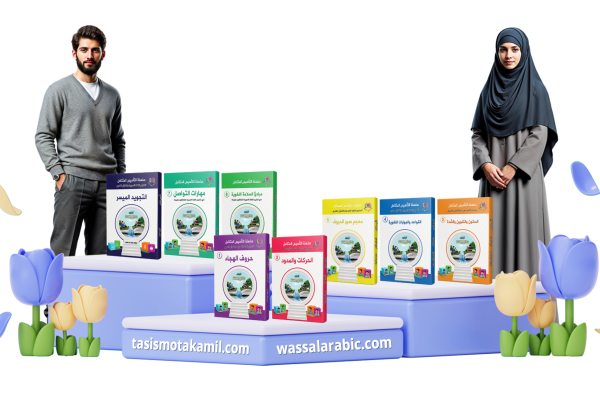
Using a well-structured educational book that includes visual aids and presents language skills gradually and in a variety of formats, employing colors and visual patterns to support vocabulary building — such as the AL Tasis Al Motakamil series.
-
Using an educational app that includes audio recordings of the texts studied — like the AL Tasis Al Motakamil app.
-
Engaging in real communication in Arabic with the teacher inside and outside the classroom.
-
Watching educational clips or dubbed cartoons in Classical Arabic, followed by interactive activities (e.g., retelling the events).
Practical Example:
Listening to or reading a picture-based story titled “The Day Off”, followed by answering simple oral questions.
In this activity, students listen to a short story (1–2 minutes long) titled “The Day Off”, accompanied by illustrative images, or the teacher/student reads the story aloud from the book.
Then, the teacher asks oral questions like:
-
Who was in the story?
-
What happened on the day off?
-
Where did Omar go on his day off?
Purpose of the activity:
-
To train the learner’s ear to comprehend short texts.
-
To develop active listening skills and the ability to associate sounds with images.
Second: Speaking Skill
Objective of the Skill:
To enable the learner to pronounce Arabic sounds clearly and build sentences that express their thoughts.
Suggested Methods:
-
Imitation and phonetic modeling by following the teacher’s pronunciation and body language.
-
Phonetic exercises for jaw movement and tongue positioning using techniques like segmentation, spelling out sounds, repetition, and sound comparison.
-
Gradual progression from parts to wholes, e.g., from sound segments to vocabulary, then to short sentences, and finally to complete dialogue situations.
-
Understanding the meanings of the phonetic segments and the vocabulary being used.
-
Using familiar and essential words and phrases from the student’s environment, avoiding synonyms or new vocabulary until mastery is achieved.
-
Conducting dialogue activities and role-playing scenarios.
-
Employing interactive strategies that support comprehension and lead to correct usage.
Supporting Tools:
-
A suitable textbook with rich illustrations and visual cues, structured gradually, and using color-coded patterns to build mental maps — such as highlighting vowel markings, emphatic letters, and interdental sounds — helping learners avoid pronunciation errors. Example: AL Tasis Al Motakamil books.
-
Recording the student’s voice to compare their initial performance with improved speaking.
-
Using educational applications that support pronunciation training based on approved models — such as the AL Tasis Al Motakamil app.
-
Communicating in Arabic with the surrounding environment: family, teacher, classmates.
-
Holding weekly sessions for speaking exclusively in Arabic.
Practical Example:
Activity: “What would you say in this situation?”
Students are shown an image depicting a real-life scenario, such as:
-
A child shopping at a store
-
A person who missed the bus
-
A student introducing themselves on the first day of school
They are asked to describe or respond to the situation using simple spoken sentences.
Steps:
-
The student describes what they see in the picture (e.g., “This is a boy at the market. He is buying apples.”).
-
The teacher asks guiding questions like: “What would you say if you were in this situation?” or “How would you reply to the seller?”
-
The student practices speaking in 3 to 5 simple sentences, with room for repetition and improvement.
Purpose of the activity:
-
To enhance spoken fluency in everyday contexts.
-
To help the learner construct correct sentences that express personal thoughts.
-
To build self-confidence in interactive communication situations.
رائع جدًا، شكرًا لإرسالك الجزء الثاني!  الآن أقدّم لك الترجمة الإنجليزية الكاملة لهذا الجزء بنفس النمط الأكاديمي والمنهجي المتّبع في الجزء الأول، مع الحفاظ على التناسق، المصطلحات، والأسلوب التعليمي:
Third: Reading Skill
Skill Objective: To enable the learner to read texts accurately, in both Qur’anic and orthographic (standard) scripts, whether the text is fully vowelized or not, according to their level.
Suggested Methods:
- Segmenting, spelling, repeating, and chanting with a specific instructional rhythm.
- Correcting pronunciation by adjusting tongue placement and distinguishing between similar sounds.
- Using interactive reading strategies to understand the studied rule and expand vocabulary.
- Training on the grammatical rule associated with the text.
- Activating prior knowledge and vocabulary to support reading comprehension.
- Progressing gradually from parts to whole — starting from phonetic segments, to words, then sentences.
- Applying interactive techniques that boost comprehension and lead to accurate application of reading skills.
Supporting Tools:
- A well-designed textbook with visual aids and color-coded layouts that build mental maps, such as highlighting vowels, emphatic letters, and interdental sounds — to help students avoid pronunciation and reading errors. Example: AL Tasis Al Motakamil.
- Leveraging technology to display content and engage students — such as interactive whiteboards or projectors. The electronic version of AL Tasis Al Motakamil can also be used for interactive classroom presentations.
- Educational apps that offer interactive reading practice in a fun and engaging way — such as the AL Tasis Al Motakamil app.
- Using flashcards with words and sentences as visual aids to reinforce vocabulary and encourage interaction.
- Organizing reading competitions to create an exciting, motivating classroom environment.
Practical Example: Reading a short story and then reordering its events in small groups.
A short text (e.g., a dialogue from “Arabic Communication”) is distributed, consisting of 4–6 sentences printed on separate, shuffled cards.
Steps:
- Students read each sentence aloud.
- In groups, they work together to reorder the sentences based on logical sequence.
- Each group presents and explains their chosen order.
Objective of the activity:
- Strengthening analytical reading and overall comprehension.
- Training students to connect ideas and sequence events logically.
- Promoting cooperative learning in a fun and engaging format.
Fourth: Writing Skill
Skill Objective: To enable the learner to write correctly while observing spelling rules and improving handwriting.
Suggested Methods:
- Early exposure through coloring and tracing exercises before the age of five.
- Hand and finger training through air-writing or tracing movements.
- Teaching how to hold the pencil and form letters, gradually leading to spelling rules.
- Engaging students in interactive writing exercises such as copying, ordering, completing, composing, analyzing, spelling, and expressing.
- Starting with familiar sentences and gradually expanding to full paragraphs.
Supporting Tools:
- A dedicated writing textbook that uses color, visual cues, guiding arrows, and lined spaces, presented in a step-by-step format — as seen in the AL Tasis Al Motakamil series.
- Availability of proper writing supplies: ergonomic chairs, suitable tables, whiteboards, pens, flashcards, and writing notebooks.
- Correct body posture and seating position to support accuracy and comfort during writing.
- Interactive applications that allow students to practice writing letters and words in an engaging way.
- Organizing handwriting and spelling contests within a motivating classroom environment that encourages creativity and excellence.
Practical Example: “Be a Little Author” – Students are asked to write a short story using vocabulary learned in the unit.
Process:
- Brainstorming ideas for the story with the class.
- Dividing the story into a beginning, middle, and end.
- Writing a draft, followed by revision with the teacher.
- Displaying the final stories on the class “Creative Wall.”
Objective of the activity:
- Fostering creative writing in students.
- Enhancing vocabulary usage in contextual expression.
- Building confidence and fluency in written communication.
 Integration of the Four Language Skills
It is essential to understand that the four language skills — listening, speaking, reading, and writing — do not function in isolation. They are interdependent, and a balanced development among them leads to comprehensive language mastery.
Listening supports better speaking, and sustained reading strengthens writing. Vocabulary richness is the driving force behind all these skills, fueling the learner’s ability to communicate effectively both in spoken and written forms.
Skill Assessment
No educational process is complete without effective assessment tools to measure the learner’s progress across different skills. Recommended methods include:
- Audio recordings to evaluate listening and speaking.
- Student portfolios to track writing development over time.
- Observation checklists during group reading sessions to measure fluency and accuracy.
- Interactive classroom activities, such as contests and language games, to assess applied skills.
Theoretical Framework
This educational model draws primarily on the communicative approach, which is considered one of the most effective methods for teaching Arabic to non-native speakers. It focuses on real-life language use and situational learning.
Additionally, it incorporates aspects of the behaviorist approach in phonetic and oral training — emphasizing repetition, correction, and structured practice.
Conclusion
In light of the above, it becomes clear that developing the four language skills — listening, speaking, reading, and writing — is not a matter of pursuing isolated objectives. Rather, it is a comprehensive framework that nurtures learners into confident, capable language users.
The AL Tasis Al Motakamil curriculum stands out as an effective model for achieving this balance, thanks to its gradual structure, interactive methods, and modern learning tools that suit diverse age groups and learning levels.
Investing in these skills through a well-designed methodology and a motivating learning environment leads to high-quality educational outcomes, empowering learners to achieve linguistic competence and expressive confidence.

You may also like
The Journey of Excellence Begins Here
Teaching Arabic Through a Language Environment