Memorization Alone Isn’t Enough
- Posted by أ. مصطفى وصَّال
- Date June 26, 2025
- Categories Arabic
- Comments 0 comment
How to Instill Knowledge, Skills, and Emotions in Arabic Language Learners?
Introduction:
In the journey of teaching Arabic to non-native speakers, merely delivering information isn’t sufficient. Many educators fall into the trap of focusing solely on the cognitive aspect, neglecting the deeper dimensions of learning. This article elucidates how to achieve the three primary educational objectives—cognitive, psychomotor, and affective—through practical, interactive methods that ensure impactful and sustainable learning.
1. Cognitive Objectives
These pertain to the learner’s knowledge: grammar rules, vocabulary, and comprehension of presented skills.
Suggested Methods:
Repetition and chanting with continuous review.
Emphasis on understanding and practical application rather than rote memorization.
For advanced learners: Begin with explaining the rule, then proceed to application.
For beginners: Start with practical application, then derive the rule inductively to enhance understanding.
Supporting Tools:
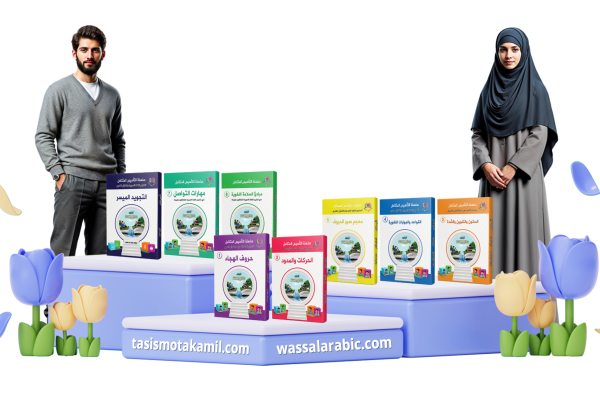
Utilize appropriate textbooks that build knowledge progressively, such as the “Integrated Foundation Curriculum” series.
Incorporate interactive activities like games and dialogues.
Leverage educational websites and applications offering interactive exercises.
Assign students to research the lesson topic beforehand or summarize it post-instruction.
Practical Example:
Before a lesson on “tanween” (nunation), students are asked to watch a short video or gather information from a textbook or educational app, preparing examples. During the class, the rule is deduced collectively and applied through exercises.
2. Psychomotor Objectives
These involve skills related to correct pronunciation, articulation, timing, accurate writing, and adherence to spelling rules.
Suggested Methods:
Live modeling: The teacher demonstrates pronunciation and writing, with students imitating both verbal and non-verbal cues.
Specific phonetic exercises to train the vocal apparatus and correct articulation.
Interactive strategies that reinforce understanding and correct skill application.
Supporting Tools:
Textbooks featuring colored diacritics and visual aids to distinguish between emphatic, dental, and disconnected letters, aiding in avoiding pronunciation and spelling errors.
Recording students’ voices for self-assessment and comparison with accurate models.
Utilizing electronic applications for reviewing and practicing phonetic skills with standardized performance.
Practical Example:
After training students on “sun and moon letters,” each student reads specific words, records their reading, and compares it to the correct model to refine pronunciation and auditory awareness.
3. Affective Objectives
These relate to the student’s feelings towards the language, the teacher, and the learning process, forming the foundation for sustained engagement.
Suggested Methods:
Consistent kindness and a welcoming demeanor.
Continuous encouragement, praising effort over results.
Fairness and equality among students.
Avoiding negative comparisons between students.
Refraining from displaying negative emotions or biases.
Active listening and empathetic interaction.
Considering individual differences when assigning tasks.
Providing curriculum suited to the student’s level.
Supporting Tools:
Symbolic gifts and rewards.
Educational and recreational trips.
Competitions based on lesson content.
Organizing linguistic, cultural, artistic, and sports contests.
Weekly honor boards displaying outstanding students.
Integrating technology and educational games into lessons.
Employing interactive strategies and active learning techniques.
Practical Example:
Organize a group competition titled “Grammar Knights,” where teams compete in solving exercises in an enjoyable manner, with symbolic prizes awarded to the winning team.
Balancing the Three Objectives
Educators should strive to balance the mind (knowledge), hands (skills), and heart (emotions). Comprehensive teaching doesn’t focus solely on the quantity of information but on the quality of learning and the student’s connection to the subject and instructor.
“Knowledge without application is futile; application without understanding is flawed; understanding without passion is unsustainable.”
Conclusion
Achieving educational objectives isn’t a random endeavor but a systematic process rooted in the teacher’s awareness of students’ levels and needs.
When instruction is directed towards these three objectives in a balanced manner, the outcome is students who love the language, master it, and are proficient across all levels.

- مدير شركة وصال للنشر والتوزيع
- مؤلف سلسلة التأسيس المتكامل
You may also like
The Journey of Excellence Begins Here
Teaching Arabic Through a Language Environment